

Customer Balance
Each customer account can have credit or debit adjustments that can be applied to future invoices. Multiple credits and debits can be added to the customer balance which would sum up to the total balance available on the customer's account. A credit (-) (meaning you owe them money) or a debit (+) (meaning they owe you money).
Overview
Each customer account maintains a balance composed of credit and debit adjustments that apply to future invoices. A credit (negative balance) means you owe the customer money, and a debit (positive balance) means the customer owes you money. This page explains how credits and debits are created, how balances are applied to invoices, and how to configure auto-apply rules. For managing invoices directly, see Invoices.
Credits
Offline Payments
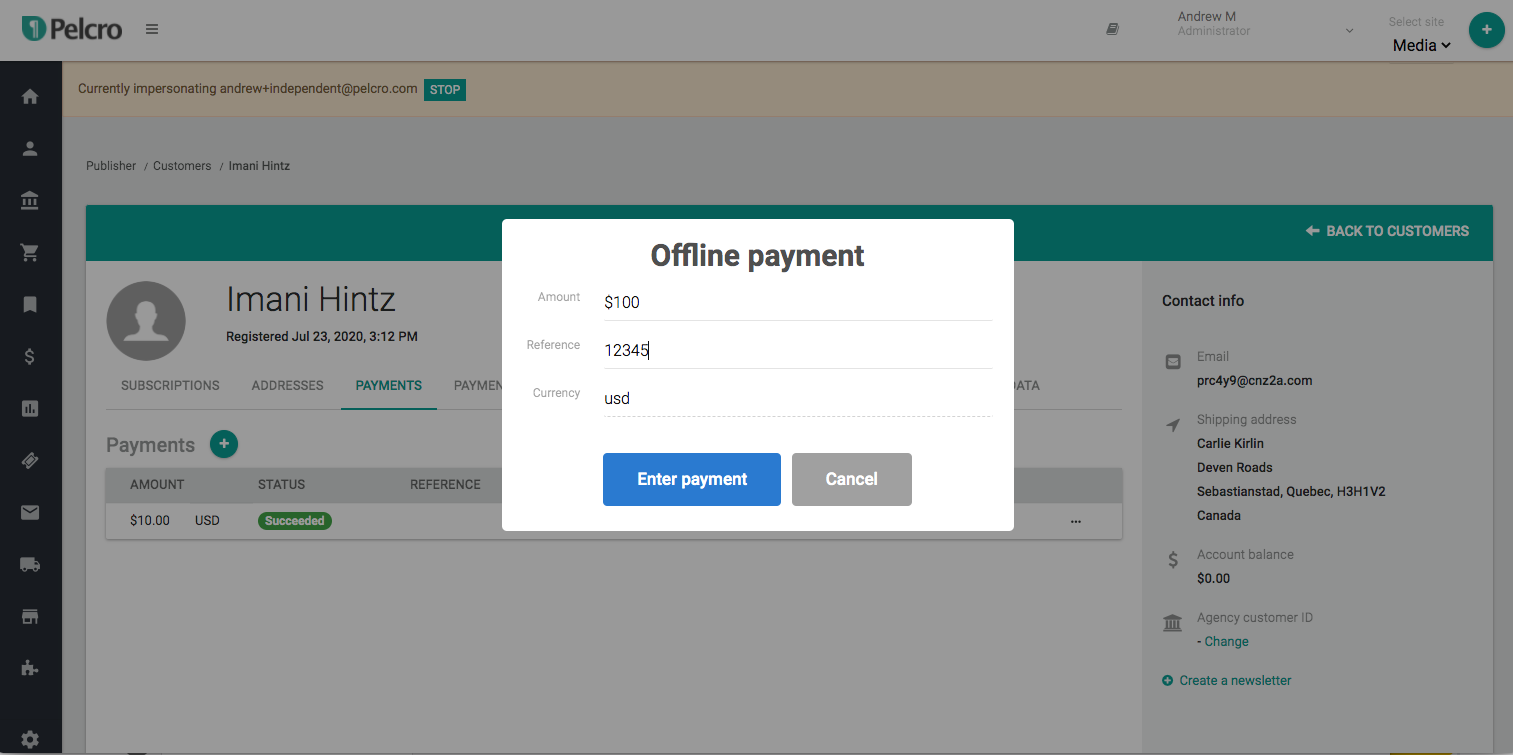
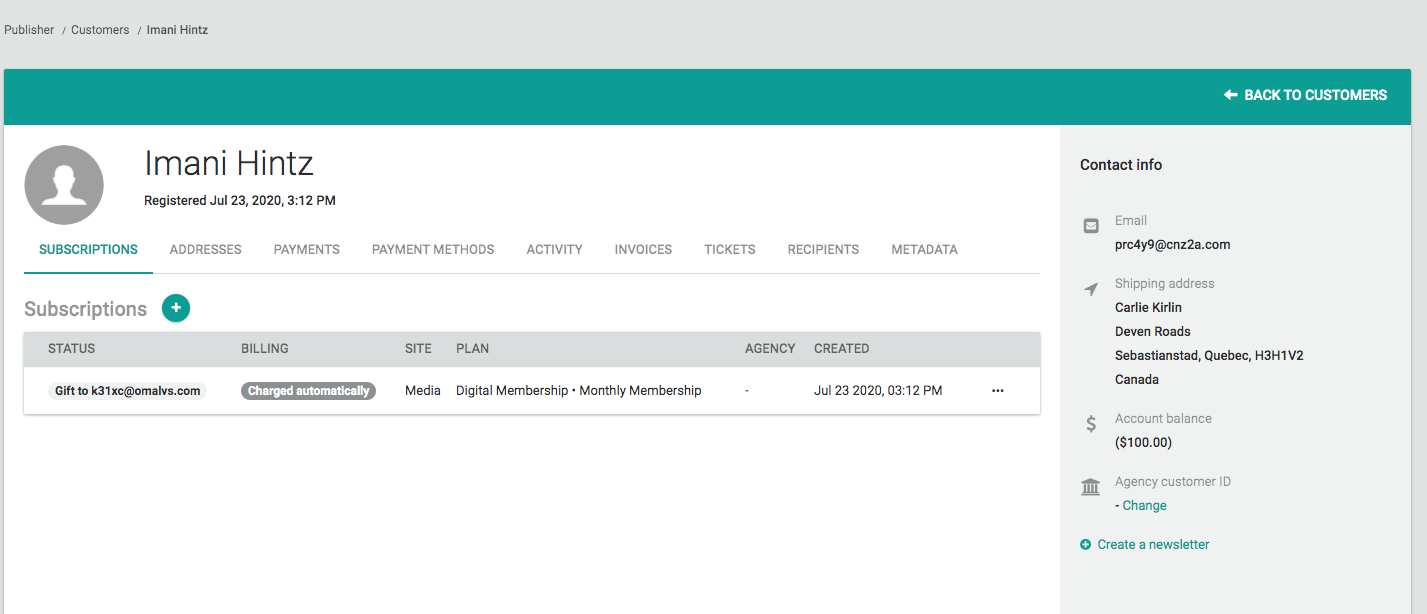
Offline payments made by customers credit the customer balance. As shown in the image below, an offline payment of $100 created a negative customer balance on the account. Offline payments can be used when a customer pays in cash, check, or any other form of payment that will not be recorded via the platform.
Canceling a subscription
When canceling a subscription, you are prompted to refund the remaining subscription amount to either the credit card or the customer balance.
-
Credit card: An online refund is issued and the customer receives the refund on their credit card.
-
Customer balance: A credit transaction is created on the customer balance and becomes available for the customer to use on any subsequent invoice.
Online Payments - Renewals
You can charge customers in advance before the phase starts by enabling this option from the settings page. Enabling this setting charges the customer for the future invoice and credits the customer balance for that invoice total.
Once the new phase starts, the invoice is created and the customer balance is used to settle it. This behavior only occurs during the renewal process, whether initiated from the platform or the user interface.
Debits
Invoice Payment
When a customer balance is applied to an invoice, a debit is created on the customer balance. If a customer has a credit balance, any subsequent invoice is paid by the customer balance in full or partially.
The customer balance is always prioritized against new invoices. Any remaining amount on the invoice after the customer balance is applied either stays open or is charged to the default payment method on file. As shown below, after creating a subscription with a $10 plan and a quantity of 5, a total of $50 was debited from the customer balance.
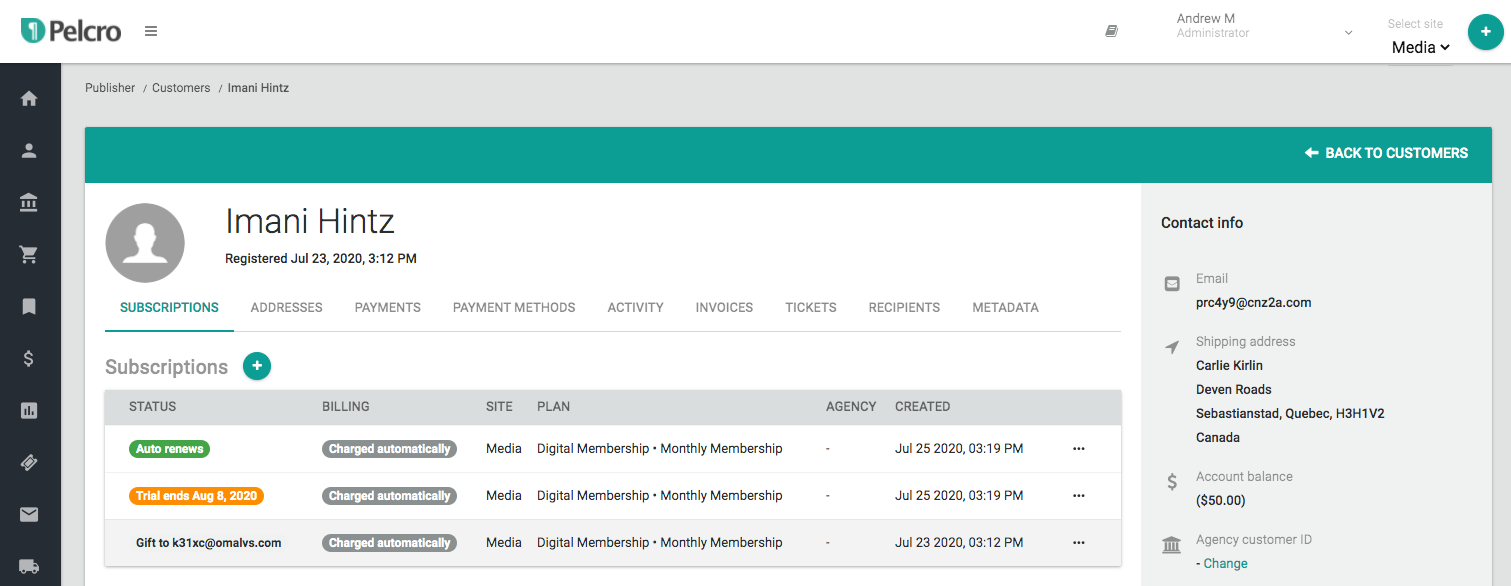
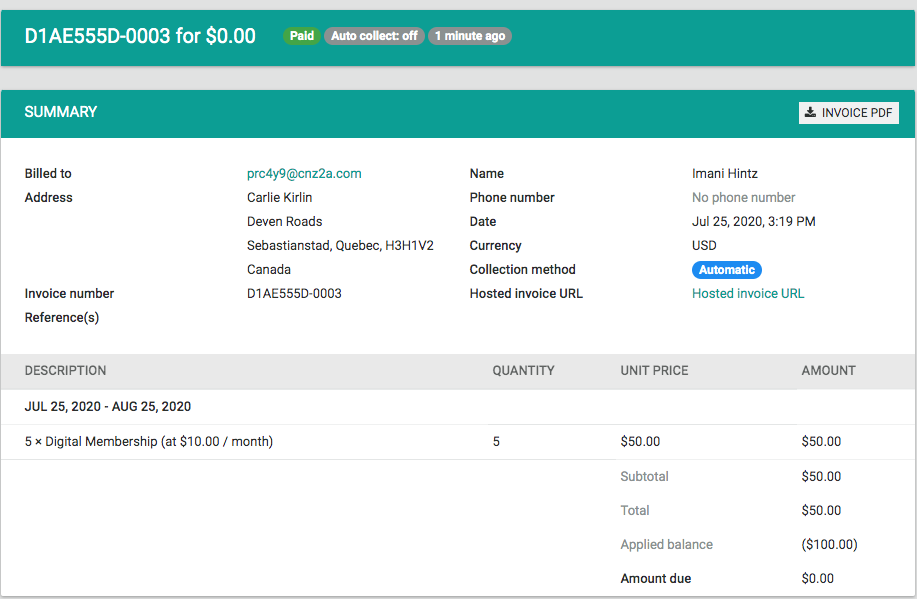
The $100 customer balance was applied to the invoice, but only $50 was used.
Refunds
Refunding an offline payment by clicking Adjust Customer Balance creates a debit as an adjustment. The customer balance adjustment is created automatically and the charge is marked as refunded offline. You are responsible for issuing the offline refund to the customer (for example, by cheque or cash).
Refunding a Balance to a Credit Card
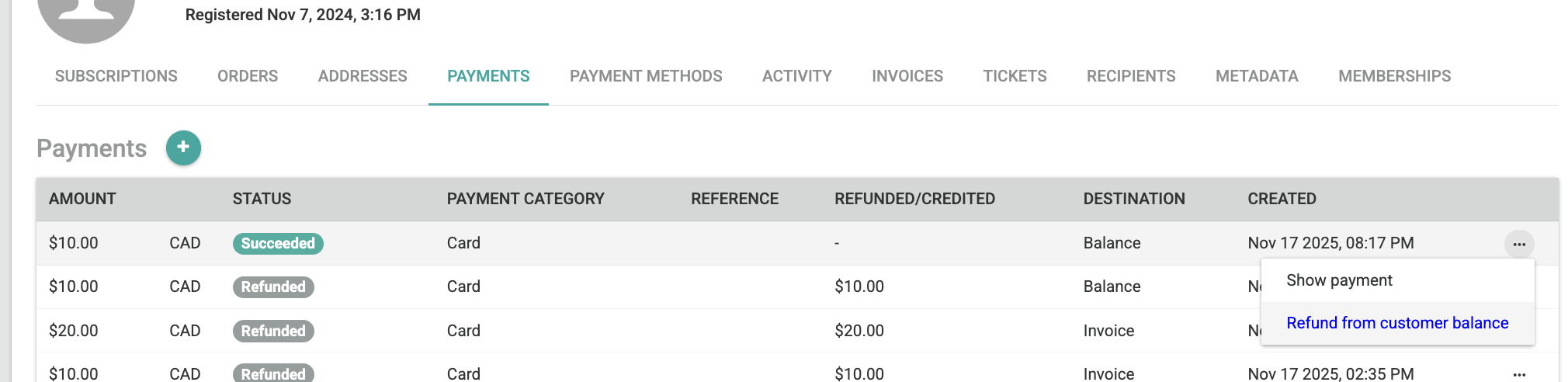
Pelcro supports refunding directly from the customer balance to the original payment method when the payment destination was the customer balance.
To refund a payment that was originally processed from a card with the destination set to the customer balance:
- Navigating to the Payment record on the platform.
- Clicking the three-dot menu (⋯) beside the payment.
- Selecting "Refund from Customer Balance."
- Confirming the refund amount when prompted.
Pelcro validates the available customer balance before processing the refund. Once confirmed, a debit adjustment is created on the customer balance to reflect the refunded amount.
Refund Logic
- If the customer balance is greater than or equal to the charge amount, the full charge amount is refunded.
- If the customer balance is less than the charge amount, only the available balance is refunded (partial refund).
- Refunds cannot exceed the original charge total.
Refund Examples
| Scenario | Charge Amount | Customer Balance | Refund Processed |
|---|---|---|---|
| Balance ≥ Charge | $50 | $80 | $50 refunded |
| Balance < Charge | $50 | $10 | $10 refunded (partial refund) |
This logic ensures accurate reconciliation and prevents over-refunds, maintaining consistency between Pelcro and your payment processor.
Customer Balance Write-Offs
The Write-Off action allows finance teams to clear stale or unresolvable customer balances directly from the platform, ensuring accurate financial states without requiring manual workarounds.
Use write-offs when a customer balance (credit or outstanding) needs to be cleared from the books — for example, when a small lingering credit is no longer worth refunding, or when an outstanding balance is deemed uncollectible.
This is only available for accounts using Pelcro's Billing Engine.
How it Works
Write-offs are applied through the Adjust Customer Balance modal as a dedicated adjustment type. When applied:
- The customer balance decreases toward zero by the write-off amount
- The action is recorded as a debit adjustment on the customer balance
- A corresponding entry is created in accounting reports under a dedicated "Balance Write-Offs" row
- No refund record, payment transaction, or payment gateway interaction is created
This makes write-offs distinct from refunds — they are an internal accounting action with no external financial movement.
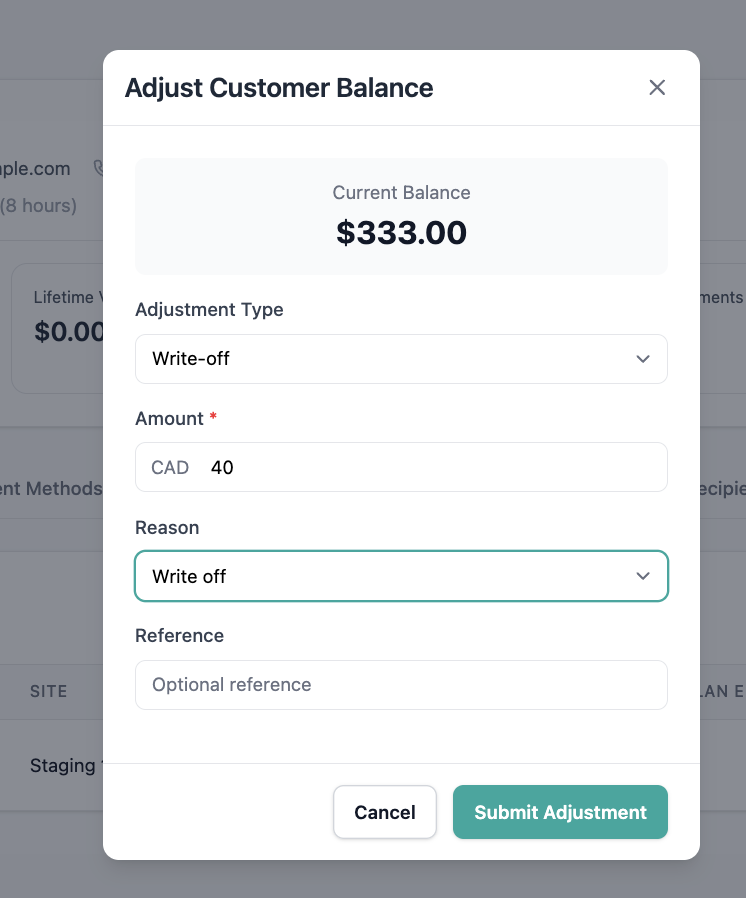
Applying a Write-Off
To write off a customer balance:
- Open the Customer Profile
- Click Adjust Customer Balance
- From the Adjustment Type dropdown, select Customer Balance Write-Off
- Enter the Amount to write off
- Select a Reason from the reasons list (the dedicated "Write-Off" reason is recommended)
- Click Save
Rules and Limitations
- The write-off amount cannot exceed the available customer balance
- Partial write-offs are supported — you can clear a portion of the balance and leave the rest active
- A reason is recommended for every write-off to support audit and reporting clarity
Accounting Impact
Write-offs are reflected in accounting reports under a dedicated row:
- Row name: Balance Write-Offs
- Customer balance column: Decreased by the write-off amount
- Recognized revenue (P&L): Adjusted as the counter-balance entry
This ensures write-offs are clearly traceable in financial reporting and do not get conflated with regular adjustments or refunds.
What Write-Offs Do Not Do
To keep accounting clean and avoid unintended side effects, write-offs intentionally exclude the following:
- ❌ No refund record is created
- ❌ No payment transaction is created
- ❌ No interaction with payment gateways
- ❌ No external customer communication is triggered
If you need to issue an actual refund to the customer, use the Refund action instead.
Customer Balance Auto-Apply Rules
The Customer Balance Auto-Apply Rules setting allows administrators to control how available customer balances are applied to invoices within the Pelcro Billing Engine.
This setting provides predictable and auditable control over balance application behavior at the account level. For related billing configuration, see Settings.
Location
Platform Path:Settings → Billing → Customer Balance Auto-Apply
This setting is configured per account and stored at the account configuration level.
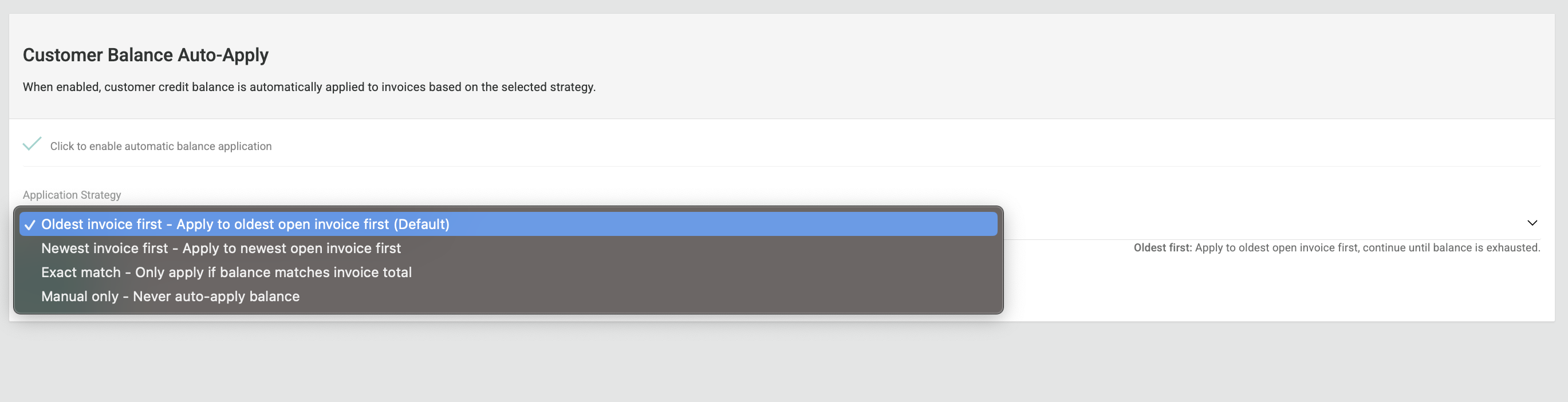
Available Options
Administrators can select one of the following rules. The table below summarizes all options, with detailed descriptions following.
| Rule | Behavior | Best For |
|---|---|---|
| Oldest Invoice First | Applies balance to oldest open invoice first (FIFO) | Standard accounting |
| Exact Amount Match | Applies only when balance exactly matches an invoice total | Strict reconciliation |
| Newest Invoice First | Applies balance to most recent open invoice first | Current-cycle billing |
| Manual Only | No automatic application; admin must apply manually | Finance-controlled environments |
1. Oldest Invoice First
- Available customer balance is automatically applied to the oldest open invoice.
- If the balance exceeds the invoice amount, the remainder is applied to the next oldest invoice.
- Continues until the balance is exhausted.
Use case: Standard accounting practice (FIFO settlement).
2. Exact Amount Match
- Balance is automatically applied only when the balance amount exactly matches an open invoice total.
- No partial applications occur.
- If no matching invoice exists, the balance remains unapplied.
Use case: Strict reconciliation environments.
3. Newest Invoice First
- Available balance is applied to the most recently generated open invoice.
- If the balance exceeds the invoice amount, the remainder is applied to the next newest invoice.
Use case: Businesses prioritizing current billing cycles.
4. Manual Only (No Automatic Application)
- Customer balances are not applied automatically.
- Balances remain available but unapplied.
- An administrator must manually apply the balance to a selected invoice.
Use case: Finance-controlled environments requiring approval before settlement.
How It Works
When:
- A new invoice is generated, or
- A new balance is added to a customer account,
The Billing Engine evaluates the account-level Auto-Apply rule and determines whether and how to apply the balance.
The rule:
- Is evaluated at invoice creation time.
- Applies only to open invoices.
- Does not override manually applied balances.
Important Notes
- Changing the setting does not retroactively reprocess past invoices.
- Only open invoices are eligible.
- Negative balances are not affected.
- Manual applications always override automatic rules.
Limitations
- You cannot apply a customer balance to a specific invoice — the balance applies only to invoices created after the balance adjustment.
- The customer balance is automatically applied to the next invoice created for the customer (unless the Auto-Apply rule is set to Manual Only).
- The customer balance currency always matches the customer currency.
This is only available for accounts using Pelcro's Billing Engine.
Troubleshooting
Refund fails due to insufficient customer balance
If a refund fails, verify the customer balance is sufficient. Pelcro validates the available balance before processing. If the balance is less than the charge amount, only a partial refund is issued. Check the customer balance on the customer profile page before retrying.
Customer balance not applied to a new invoice
Confirm the Auto-Apply Rule is not set to Manual Only. If it is, an administrator must manually apply the balance. Also verify the invoice is in an open state — closed or paid invoices are not eligible for balance application.
Changed the Auto-Apply rule but existing invoices are unaffected
Changing the Auto-Apply setting does not retroactively reprocess past invoices. The new rule applies only to invoices created or balances added after the change. To apply a balance to an existing open invoice, use the Manual Only workflow.
Refund amount exceeds expected value
Refunds cannot exceed the original charge total. If the displayed refund amount seems incorrect, verify the original charge amount and the current customer balance on the payment record. Pelcro caps the refund at the lesser of the charge amount or the available balance.
Next Steps
Updated 4 months ago